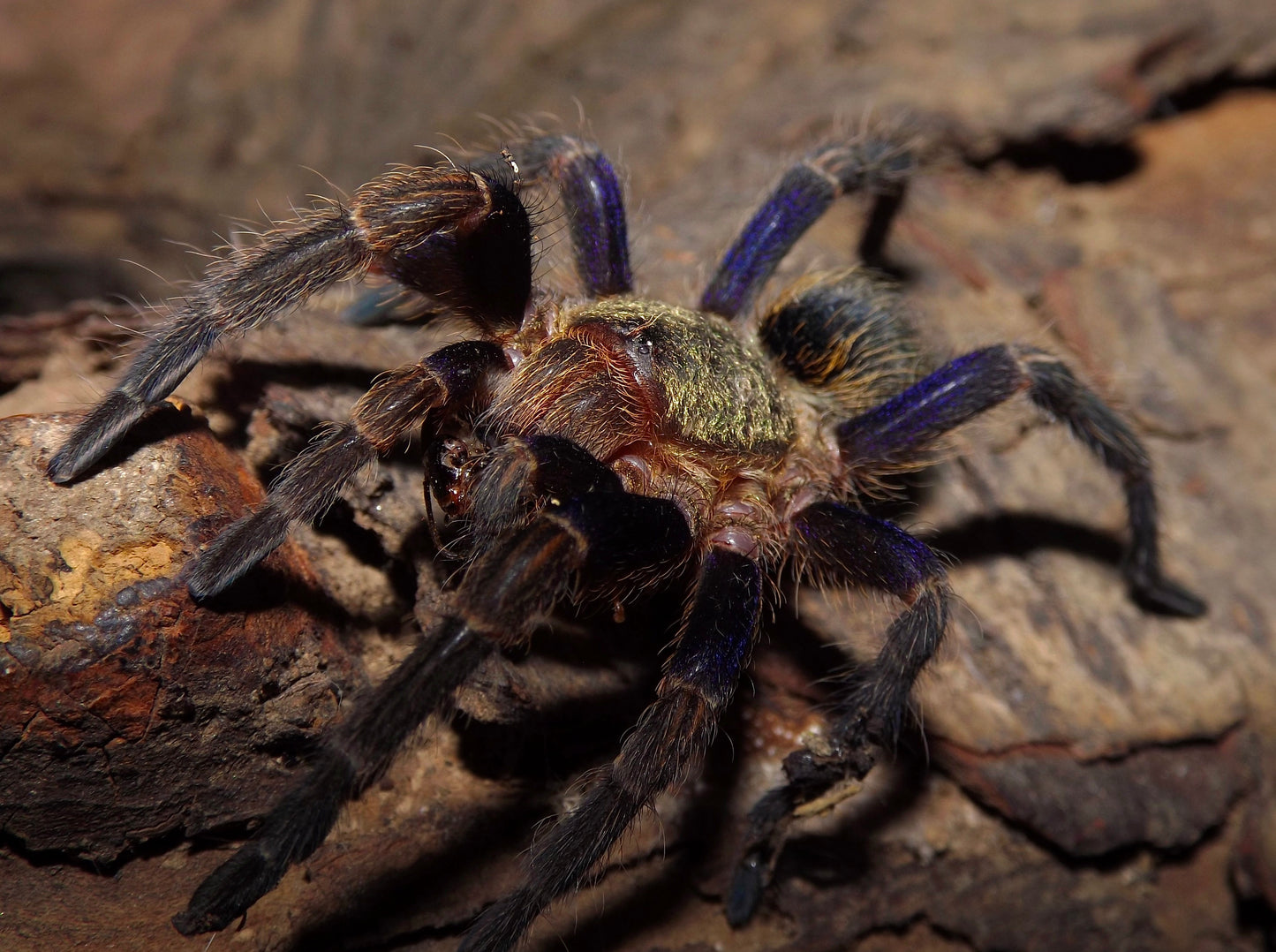
Euathlus truculentus “Blue” – Chilean Blue Femur
One of Chile’s Most Underrated Gems
Euathlus truculentus “Blue,” the Chilean Blue Femur, is one of those tarantulas that looks good in photos but completely different once you see one in person. Adults develop gorgeous metallic blue to purple femurs, a deep forest-green carapace, and dark velvety legs, with the colors changing depending on the lighting. It’s a much more subtle kind of beauty than something like a GBB or P. metallica, but in person the coloration is absolutely incredible.
Think of a More Colorful, Curious Grammostola
The easiest way I can describe this species is almost like a more colorful and even more curious Grammostola. You still get that incredibly calm, slow-moving personality and hardy nature, but E. truculentus seems genuinely interested in everything happening around it. Mine spend a ton of time sitting completely out in the open and will regularly walk around and explore their enclosure.
Extremely Docile & Tolerant of Handling
Personality is probably my favorite thing about the Chilean Blue Femur. My specimens have been extremely docile, curious, slow-moving, and very tolerant of gentle handling. They’re much more likely to calmly investigate your hand than immediately bolt or become defensive. Individual temperament can always vary, but this is easily one of the most relaxed species I’ve worked with.
A Big Euathlus
Another thing that separates the Blue Femur from many of the other Euathlus in my collection is its size. While a lot of Euathlus stay around the 3–4” range, Blue Femurs can reach around 6” DLS, giving you that classic Euathlus personality in a considerably larger animal. A full-grown female sitting out in the open with those metallic blue-purple femurs is an incredible display spider.
Hardy & Incredibly Easy to Keep
Despite how rare they are, these are extremely easy tarantulas to care for. Keep them cool and mostly dry, provide a clean water dish, and give them plenty of room to move around. I keep my Euathlus from the low 60s through the mid-70s°F, and they handle those cooler temperatures extremely well.
I also recommend giving Blue Femurs a larger footprint than you might normally give a tarantula their size. Mine genuinely enjoy exploring and will even use low cork or branches when they’re available. They spend so much time sitting out in the open that I don’t consider a traditional hide necessary.
Slow Growing & Built for the Long Haul
The tradeoff is patience. Euathlus truculentus is an extremely slow-growing species, and larger females represent years of growth that simply can’t be rushed. But that slow metabolism also comes with one of the biggest advantages of owning this genus: females can be incredibly long-lived. This isn’t a tarantula you buy expecting explosive growth. It’s the kind of animal you buy knowing it could potentially remain part of your collection for decades.
Rare for a Reason
Chilean Euathlus are becoming some of my favorite animals to collect and work with, but they’re also some of the hardest tarantulas to replace once a bloodline disappears from the U.S. hobby. Chile tightly controls its native wildlife, meaning we can’t simply assume another shipment will arrive if an established line disappears. That’s what makes animals like the Blue Femur so important to me. You aren’t just getting another colorful terrestrial—you’re getting a rare Chilean species with incredible longevity, easy husbandry, beautiful coloration, and one of the best personalities I’ve experienced in a tarantula.