
Skip to product information
1 of 4

Westside Tarantulas

Phormingochilus sp. Sabah Blue – Sabah Blue Earth Tiger - Female For Sale

Phormingochilus sp. Sabah Blue – Sabah Blue Earth Tiger - Female For Sale

Regular price $875.00
Regular price Sale price $875.00
Sale Sold out
Shipping calculated at checkout.
Size and Sex

Phormingochilus sp. Sabah Blue – Sabah Blue Earth Tiger

A Hidden Gem Among Old World Tarantulas

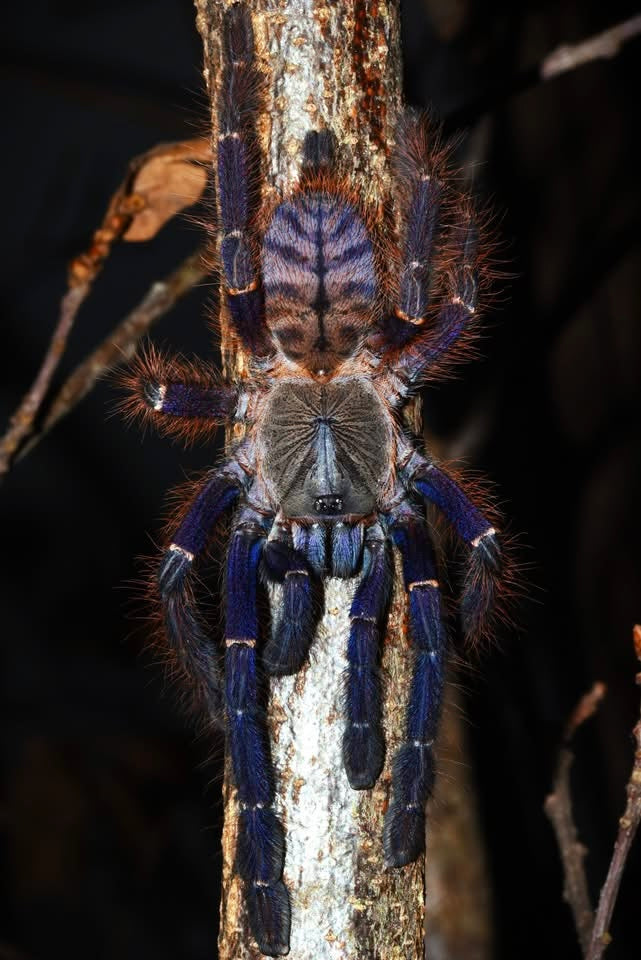
If there is one species that consistently leaves seasoned collectors speechless, it’s Phormingochilus sp. Sabah Blue. Native to the rainforests of Sabah, Borneo, this incredibly elusive Old World tarantula has earned a near-mythical reputation thanks to its breathtaking coloration and extreme scarcity in captivity. Unlike many Old World species that rely solely on speed or bold patterns, the Sabah Blue captivates with an elegant combination of deep royal blue legs, rich violet highlights, fiery orange setae, and a silvery-gray carapace that seems to shimmer under natural light. Every molt intensifies these colors, transforming an already beautiful teenager into one of the most striking arboreal bat eaters in the hobby.

An Explosion of Electric Blue & Purple

Few tarantulas can rival the sheer intensity of the Sabah Blue’s coloration. Mature specimens develop velvety cobalt-blue legs saturated with violet iridescence, contrasted by glowing copper-orange hairs surrounding the abdomen and joints. The soft silver-gray carapace provides the perfect backdrop for the vibrant blues, while the abdomen displays intricate tiger-like striping framed by fiery orange setae. Under LED lighting or direct sunlight, this species almost appears to glow, making it one of the most photogenic tarantulas you can own. Whether viewed resting on cork bark or stalking prey after dark, Phormingochilus sp. Sabah Blue looks like a living gemstone.

A Rare Prize for Advanced Collectors

Despite its incredible beauty, this species remains exceptionally uncommon in the hobby. Captive-bred specimens are produced only by a small number of dedicated breeders worldwide, and they seldom become available for sale. As demand continues to grow, finding healthy, well-started captive-bred individuals has become increasingly difficult. For collectors searching for species that stand apart from the common Old World offerings, the Sabah Blue represents a truly premium addition that very few enthusiasts will ever have the opportunity to own.

Classic Old World Intelligence

Like most members of the Old World family, the Sabah Blue is best suited for experienced keepers. Rather than relying on defensive hairs, this species depends on incredible speed, awareness, and powerful threat displays when disturbed. Fortunately, it spends much of its time utilizing cork bark retreats and elaborate web tunnels, emerging regularly during the evening to hunt or simply display its spectacular coloration. Watching one effortlessly navigate vertical cork bark with grace and precision is one of the many reasons this genus has become a favorite among advanced hobbyists.

View full details
WESTSIDE TARANTULAS

Species Profile

Everything You Need To Know At A Glance.
Experience Level
Intermediate-Advanced
Temperament
Fast & Potentially Defensive, Confident as Adults
Type
Arboreal / Old World
DLS
Adult Size
7+” DLS
Country of Origin
Malaysia — Sabah, Borneo
Life Span
♀15–20+ Years

Care & Husbandry Guide

🏠 Enclosure & Substrate

 Provide a tall arboreal enclosure, vertical cork bark, secure anchor points and several inches of moisture-retentive substrate. Place the cork so its base reaches the substrate; this lets the spider combine an elevated retreat with a webbed lower tunnel. Sabah Blues can heavily modify their retreat with silk and substrate, so leave enough room behind the cork for construction rather than creating a completely exposed vertical setup. 

🌡️ Temperature & Humidity

Aim for approximately 75–82°F under normal husbandry, with good ventilation and consistently available moisture. Multiple specialist sources recommend roughly 70–90% RH, although I would manage the actual substrate and retreat rather than chase a hygrometer number. Keep the lower substrate moist but never swampy, allowing some surface drying between watering. Successful breeding has also been documented with the female’s burrow around 80–84°F and 76–82% RH.

 🍽️ Feeding & Water 

Sabah Blues have a very strong feeding response. Juveniles can be offered appropriately sized crickets or roaches about once weekly; large females can take substantial prey, with a documented 7.5” breeding female accepting one large female Dubia or two adult males weekly while being conditioned. Always provide a clean water dish, positioned where it remains accessible despite the species’ extensive webbing.

🕷️ Species-Specific Care 

Unlike a dry-tolerant terrestrial, Sabah Blue should have access to consistent moisture without stagnant conditions. This species naturally works with vertical structure, webbing and substrate to create a protected retreat. Keep the lower substrate moderately moist while maintaining good ventilation, and give the spider a tall piece of cork bark extending down into the substrate so it can construct a webbed tunnel behind and beneath it. Do not continually soak the enclosure, but don’t allow an established adult’s entire setup to remain bone dry for prolonged periods either. Breeding observations have successfully maintained the female’s retreat at roughly 76–82% RH.