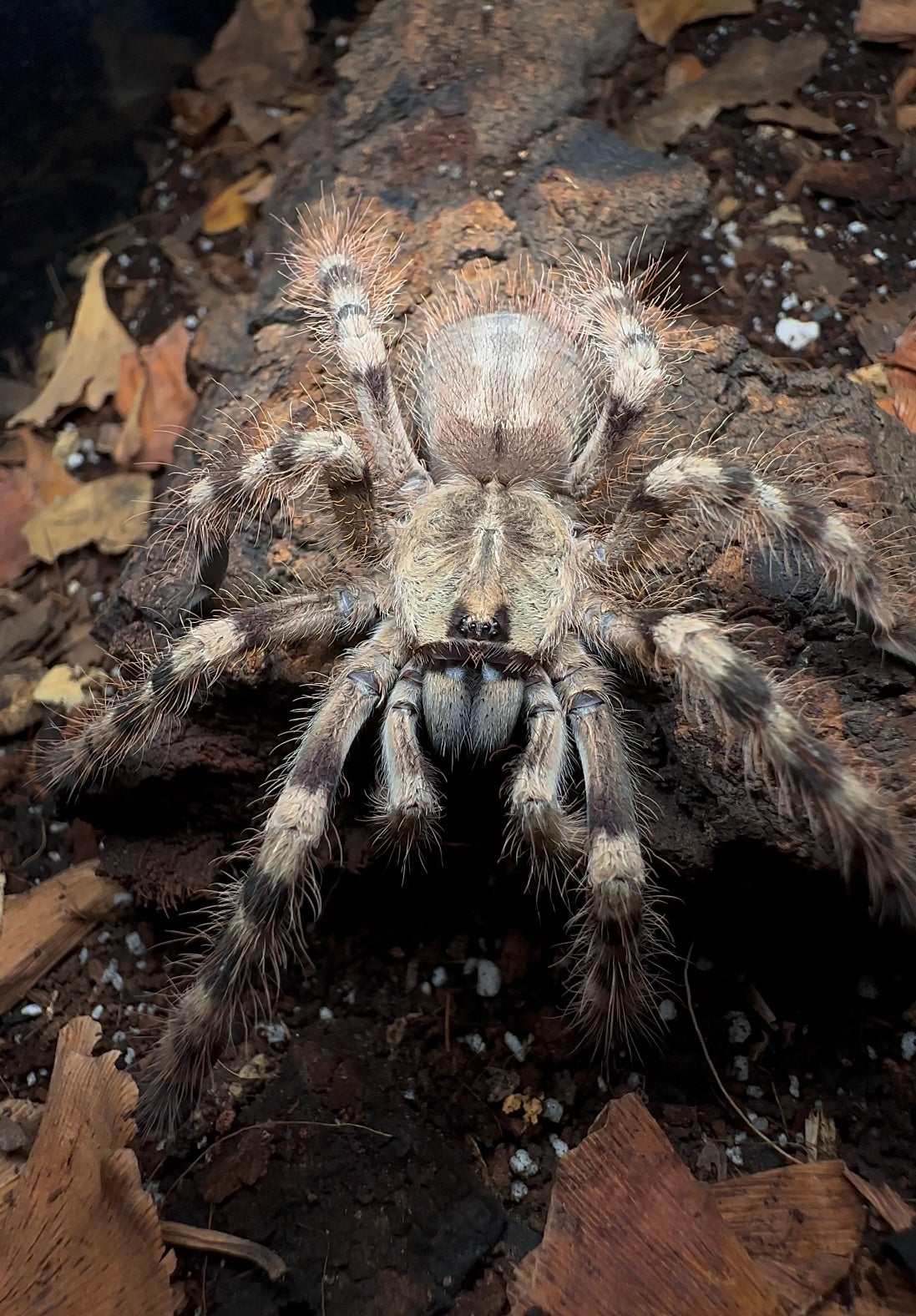
The Salem Ornamental (Poecilotheria formosa)
The Purple Ghost of the Indian Forests
One of the Most Beautiful Poecilotheria Ever Discovered
While species like P. metallica and P. regalis often steal the spotlight, many veteran ornamental keepers consider Poecilotheria formosa to be one of the most beautiful species in the entire genus. Commonly known as the Salem Ornamental, this breathtaking arboreal species combines dramatic silver and charcoal patterning with striking violet, lavender, and deep purple undertones that become increasingly apparent as the spider matures. Under proper lighting, adult females develop an almost smoky-purple appearance that gives them a completely different aesthetic than the brighter, more commonly kept ornamentals. Elegant, mysterious, and undeniably beautiful, the Salem Ornamental is a species that only becomes more impressive with age.
A Rare Collector’s Species
Despite its incredible beauty, Poecilotheria formosa remains surprisingly scarce in the hobby. Unlike Regalis, Metallica, or Miranda, Formosa is produced in much smaller numbers and rarely appears for sale in significant quantities. As a result, many collectors spend years building ornamental collections without ever encountering a true Formosa. This scarcity, combined with its unique coloration and excellent communal potential, has made it one of the most sought-after species among dedicated Poecilotheria enthusiasts.
One of the Best Communal Ornamentals
Perhaps the most exciting aspect of Poecilotheria formosa is its exceptional reputation as a communal species. When raised together from a young age, Formosa often demonstrates remarkable tolerance toward its siblings, making it one of the most successful communal candidates within the entire Poecilotheria genus. In fact, many experienced keepers will tell you that Poecilotheria are best appreciated in a communal setting. Not only does a communal create a far more impressive display, but the spiders themselves often become noticeably more confident, more visible, and more active. Instead of seeing a single ornamental emerge from its retreat, you’ll witness multiple spiders utilizing different areas of the enclosure, interacting with one another, and competing for feeding opportunities. As a result, there is simply more life, more movement, and more excitement occurring inside the enclosure at all times.
Fast Growing, Intelligent & Always Visible - (In a Communal)
Another fascinating benefit of communal keeping is that Poecilotheria often become more food-oriented and exhibit faster growth rates when raised communally. Seeing neighboring spiders feeding appears to trigger stronger feeding responses throughout the group, resulting in more aggressive feeding behavior and often quicker overall development. Watching several Salem Ornamentals emerge simultaneously to feed is one of the most spectacular sights in the hobby and something that simply cannot be replicated with a single specimen. For best success, start with sibling spiderlings whenever possible, provide a spacious vertical enclosure with multiple cork bark retreats, abundant climbing surfaces, constant access to water, and feed generously. When properly maintained, a thriving Poecilotheria formosa communal becomes one of the most rewarding and awe-inspiring displays an invertebrate keeper can own.
The Ultimate Ornamental Display
For keepers seeking something truly special, Poecilotheria formosa offers an incredible combination of rarity, beauty, communal potential, and impressive adult size. Whether you’re looking to establish a communal display or simply add one of the most elegant ornamentals ever discovered to your collection, the Salem Ornamental delivers everything that makes Poecilotheria one of the most beloved genera in the hobby.