
Skip to product information
1 of 3

Westside Tarantulas

Poecilotheria Striata - Mysore Ornamental - Female For Sale

Poecilotheria Striata - Mysore Ornamental - Female For Sale

Regular price $715.00
Regular price Sale price $715.00
Sale Sold out
Shipping calculated at checkout.
Size and Sex

Poecilotheria striata – Mysore Ornamental

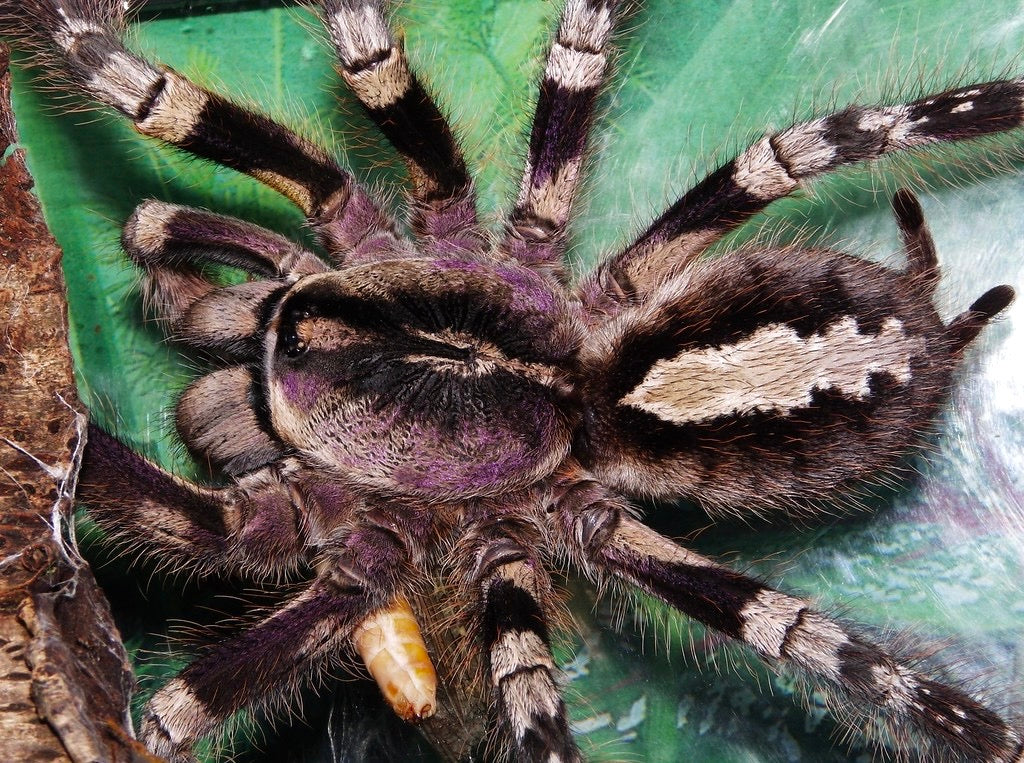
Classic Poecilotheria With a Purple Twist

The Poecilotheria striata, better known as the Mysore Ornamental, is one of those Pokies that looks better the closer you get. At first glance you get the classic black-and-cream Poecilotheria pattern, but under good lighting the carapace and legs reveal gorgeous purple and violet undertones that completely change the look of the spider.

That Sexy Ornamental Pattern

What really makes P. striata stand out is its contrast. Bold cream markings run across the abdomen and legs against a dark base, while subtle purple coloration comes through around the carapace and femurs. Mature females become especially impressive, developing into large, heavily patterned arboreals that look incredible sitting vertically against cork bark.

Fast Growing & Always Ready to Eat

Like most Poecilotheria, these spiders don’t waste much time putting on size. Juveniles grow quickly when kept warm and consistently fed, and they typically have an excellent feeding response. This makes P. striata especially rewarding to raise—you aren’t waiting years for a tiny sling to finally resemble the adult you purchased it for.

An Underrated Poecilotheria

Species like P. metallica tend to steal the spotlight, but that’s part of what makes P. striata so cool. It has the size, speed, intricate patterning and unmistakable look of the genus while being considerably less common in many collections. If you’re building a serious Poecilotheria collection, the Mysore Ornamental absolutely deserves a spot in it.

Communal Care 

For established communals raised together from an early age, use roughly the enclosure footprint you would normally give a single P. striata while adding considerably more vertical structure—three communal specimens can comfortably utilize the vertical space normally provided to one. Add multiple pieces of cork bark so every spider can establish a retreat and find a safe position for molting. Feed communal groups heavily and consistently. As a starting point, provide roughly 2–3× the normal feeding ration and distribute prey throughout the enclosure so every spider has an opportunity to feed. For example, a group of three may receive around nine appropriately sized crickets during a feeding. Keep communal temperatures slightly cooler at approximately 68–75°F. For groups larger than five specimens, a bioactive enclosure is recommended to help manage waste and maintain a more stable long-term environment. Communal specimens should be monitored closely during feeding and molting, with adequate food and vertical retreat space maintained at all times.

View full details
WESTSIDE TARANTULAS

Species Profile

Everything You Need To Know At A Glance.
Experience Level
Intermediate
Temperament
Fast, Alert & Retreat-Oriented
Type
Arboreal / Old World / Communal
DLS
Adult Size
7”+ DLS
Country of Origin
India
Life Span
♀15–20+ Years

Care & Husbandry Guide

🏠 Enclosure & Substrate

Use a vertically oriented arboreal enclosure with excellent ventilation and multiple pieces of upright cork bark. Give the spider enough height to climb and enough space behind the cork to establish a webbed retreat. Secure enclosure doors are especially important with this exceptionally fast species.

🌡️ Temperature & Humidity

Keep approximately 72–80°F with moderate humidity and strong ventilation. Keep the lower substrate slightly moist while allowing the upper layers to periodically dry. Avoid constantly wet or stagnant conditions and always provide access to fresh water.

 🍽️ Feeding & Water 

P. striata has a strong feeding response and grows quickly when fed consistently. Juveniles can be offered appropriately sized prey 1–2 times per week, while larger specimens can receive proportionally larger meals less frequently. Remove uneaten prey, especially when a spider is approaching a molt.

🕷️ Species-Specific Care 

Poecilotheria striata is a fast-growing arboreal species that does best with plenty of vertical structure. Provide a tall enclosure with good cross-ventilation, several inches of substrate, and vertical cork bark with space behind it to create a secure retreat. This species is extremely fast and possesses medically significant venom, so handling is not recommended.