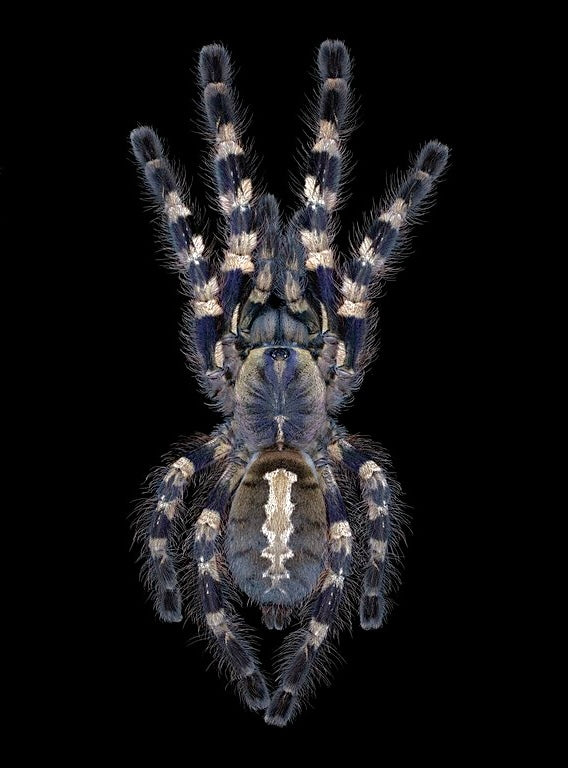
Poecilotheria tigrinawesseli – Wessel’s Tiger Ornamental
The Purple Tiger of the Poecilotheria World
If there is one Poecilotheria species that deserves far more attention than it receives, it’s Poecilotheria tigrinawesseli. Commonly known as Wessel’s Tiger Ornamental, this breathtaking species combines everything collectors love about the genus—massive size, explosive feeding responses, incredible intelligence, and jaw-dropping coloration—into one truly remarkable package. While many ornamentals rely on silver and cream tones, Tigrinawesseli takes things in an entirely different direction. The moment you see an adult specimen, it becomes obvious why this species has developed a cult following among serious Poecilotheria enthusiasts.
Insane Purple Coloration & Tiger-Like Striping
The defining feature of P. tigrinawesseli is its unbelievable coloration. Deep violet, lavender, charcoal, and silver hues blend together to create one of the most striking appearances found anywhere in the tarantula hobby. The bold tiger-like striping running down the legs and abdomen gives this species an aggressive, exotic appearance unlike any other ornamental. Under proper lighting, mature specimens often display an almost metallic purple sheen across the legs and body that simply doesn’t translate well through photographs. It’s one of those rare species that looks even better in person than it does online. For collectors who appreciate purple tarantulas, there are very few species that can compete with the visual impact of a mature Wessel’s Tiger Ornamental.
A True Collector’s Species
Unlike Regalis, Metallica, or Miranda, Poecilotheria tigrinawesseli remains relatively uncommon in collections, making it highly desirable among serious hobbyists. It isn’t a species that beginners stumble across at every reptile expo or online vendor. Instead, it remains one of those “if you know, you know” tarantulas that experienced collectors actively seek out. The combination of rarity, unique coloration, and impressive adult size has made this species one of the hidden gems of the Poecilotheria genus.
Massive, Intelligent & Always on Display
Like many Poecilotheria species, Tigrinawesseli tends to be far more visible than most arboreal tarantulas. They frequently perch on cork bark, enclosure walls, or elevated retreats where their incredible patterning can be appreciated daily. Combined with their rapid growth rate and legendary feeding response, they quickly become one of the most entertaining species in any collection. Mature females can approach 8 inches DLS, creating an absolutely stunning display animal that never fails to attract attention.
The Ornamental That Stops People in Their Tracks
Every collector has a species that visitors immediately notice—and for many keepers, that species is Poecilotheria tigrinawesseli. Between the dramatic tiger striping, rich purple coloration, impressive adult size, and elite collector status, this species possesses the complete package. It is the kind of tarantula that makes people stop, stare, and ask, “What species is that?” If you’re looking for one of the most visually impressive arboreals on the planet, Wessel’s Tiger Ornamental belongs at the very top of your wishlist.