
Skip to product information
1 of 2

Westside Tarantulas

Poecilotheria vittata - Ghost Ornamental - 7 inch Female - For Sale

Poecilotheria vittata - Ghost Ornamental - 7 inch Female - For Sale

Regular price $1,150.00
Regular price Sale price $1,150.00
Sale Sold out
Shipping calculated at checkout.
Size and Sex

Poecilotheria vittata – Ghost Ornamental

The Ghost of the Poecilotheria Genus

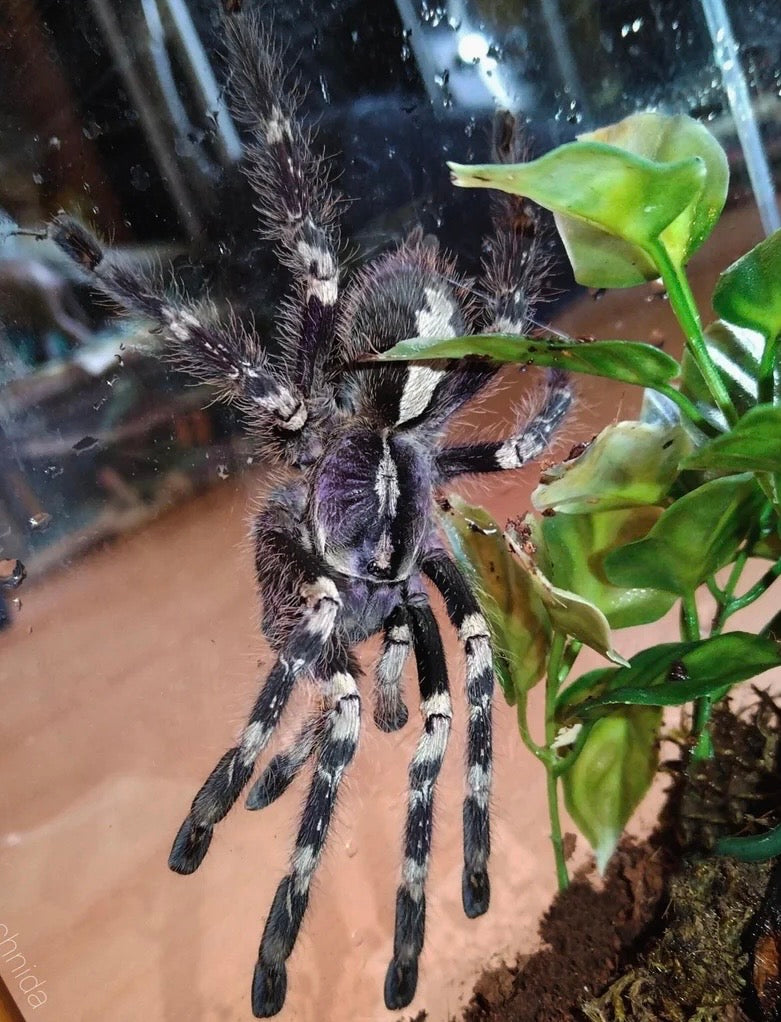
There is something completely different about Poecilotheria vittata. While species like metallica and rufilata grab your attention with explosive color, the Ghost Ornamental earns its name with an almost supernatural appearance—silver, charcoal, ivory and subtle lavender-purple tones broken apart by bold black markings. Against cork bark, an adult can practically disappear in plain sight.

One of the Most Underrated Pokies

Look closely at a mature female and this species becomes seriously impressive. The carapace develops beautiful lavender and violet undertones, while the abdomen carries a huge ivory center marking surrounded by deep blacks and browns. Long banded legs finish off that classic Poecilotheria look. Females commonly reach around 6–7+ inches DLS, giving you a large display spider without losing the slender, athletic build that makes this genus so beautiful. 

Built to Disappear

This coloration actually makes sense when you see vittata against natural bark. In the wild these arboreal tarantulas utilize tree hollows, spaces beneath bark and rock crevices, and their broken silver-and-black pattern works incredibly well as camouflage. Give one a naturalistic vertical enclosure with cork and you’ll quickly understand where the “Ghost Ornamental” name comes from. 

A True Collector’s Poecilotheria

P. vittata also has an interesting taxonomic history. Many longtime hobbyists will recognize Poecilotheria pederseni—that name is now treated as a synonym of P. vittata. The World Spider Catalog currently recognizes P. vittata as an accepted species and lists its distribution as India and Sri Lanka. 

Fast Growth. Big Appetite. Incredible Adults.

This is exactly what makes raising Poecilotheria so rewarding. P. vittata grows quickly, readily takes prey, and transforms dramatically as it matures. Youngsters become increasingly patterned with every molt until you end up with that huge, ghostly ornamental crawling across the cork.

If your collection already has the bright blues, greens and yellows covered, add the Ghost. P. vittata brings something completely different to a Poecilotheria collection.

View full details
WESTSIDE TARANTULAS

Species Profile

Everything You Need To Know At A Glance.
Experience Level
Intermediate
Temperament
Alert, Shy & Retreat-Oriented
Type
Arboreal / Old World / Communal
DLS
Adult Size
7+” DLS
Country of Origin
India / Sri Lanka
Life Span
♀15–20+ Years

Care & Husbandry Guide

🏠 Enclosure & Substrate

Use a tall, well-ventilated arboreal enclosure with several inches of moisture-retentive substrate and a substantial piece of vertical cork bark. Leave a dark gap behind the cork so the spider can retreat completely, and add additional cork or branches to create usable climbing and molting surfaces. Adults can reach around 6–7+” DLS, so mature females need enough height to comfortably stretch out and molt.

🌡️ Temperature & Humidity

72–80°F is a good working range. Maintain moderate moisture by periodically wetting a portion of the substrate rather than constantly misting the entire enclosure. Allow the upper layer to partially dry while retaining some moisture underneath. Strong cross ventilation is important—humid does not mean stagnant or constantly wet.

 🍽️ Feeding & Water 

Juveniles have an excellent feeding response and can be offered 1–2 appropriately sized crickets or roaches per week. Larger juveniles and adults can receive larger meals every 7–10 days depending on body condition. Keep a clean water dish available at all times. Their fast growth doesn’t require power-feeding; consistent meals and access to water are more important.

🕷️ Species-Specific Care 

P. vittata is a fast-growing arboreal that does best with vertical structure, a secure retreat, moderate moisture, and plenty of airflow. Give it a large piece of upright cork bark with a narrow space behind it where the spider can build its webbed retreat. Once established, they spend a surprising amount of time visible on the cork, especially after dark. Keep the lower substrate slightly moist while allowing the surface to partially dry between waterings.